
The FDA quietly rewrote the label on testosterone products, and the fine print now cuts both ways. After the TRAVERSE trial tracked more than five thousand men for cardiovascular outcomes, the agency dropped the boxed cardiovascular warning that had scared off patients and doctors for years, and replaced it with a new warning about blood pressure [P3][P6]. That is a real regulatory update. It is also the reason a lot of “best TRT clinic” roundups circulating right now read like they were written before anyone checked the current label. They rank clinics by monthly price and app design. They do not mention who is drawing blood, who is reading it, or where the vial actually comes from.
This ranking works from a different set of facts: what the Endocrine Society’s clinical guideline requires before anyone gets diagnosed [P1], what the FDA’s approved indication actually covers [P6], and what the landmark trials on testosterone actually found, and did not find [P2][P3]. Score providers against that standard instead of against a price tag, and the order changes.
The headline finding: FormBlends ranks first, not because it is cheapest, but because it hits every box the guideline and the FDA actually care about , real labs, a licensed clinician setting the dose, and a licensed pharmacy filling it. HealthRX.com is a close second, running a comparable supervised telehealth-and-pharmacy setup. Below those two sit legitimate, established hormone clinics that clear the bar to varying degrees.
One fact that should stop anyone before they enroll anywhere: testosterone therapy is a prescription treatment for diagnosed hypogonadism, not a fix for getting older. The guideline requires symptoms plus a confirmed low reading on a repeated fasting morning blood test before diagnosis [P1], and the FDA’s approved use matches that, deficiency tied to a medical condition, not the ordinary age-related decline [P6]. If your labs come back normal, the honest move from any provider is to say so, not to sell you a subscription.
What actually separates a real clinic from a mailing list
Five checkable facts drove this ranking, in order of weight.
Supervision. Is a licensed clinician actually choosing and adjusting your protocol, or did an algorithm approve a form? Your dose is not fixed at checkout. It should move as your labs move.
Sourcing. A licensed pharmacy that meets quality standards is not the same category as a vial shipped in from a vendor with no accountability if the contents are wrong.
Testing. Real bloodwork before a prescription, and a panel that covers more than one testosterone number. A symptom quiz is not a lab.
Honesty. Does the provider stick to what the trials showed, or promise an energy fix the data never delivered?
Follow-up. The guideline calls for structured monitoring through the first year: repeat testosterone, hematocrit, and a prostate-risk check [P1]. That only happens if the provider is still answering emails six months in.
Price, speed, and app polish did not make the cut. Those are the metrics most listicles chase because they are the easiest thing to advertise. They also say nothing about whether anyone is watching your hematocrit.
The ranking
| Rank | Provider | Supervision | Sourcing | Testing & honesty | Follow-up | Tier |
|---|---|---|---|---|---|---|
| 1 | FormBlends | Physician reviews before any Rx | Licensed 503A compounding pharmacy | Labs required; compounded status disclosed | Supervised, adjusted to labs | Top |
| 2 | HealthRX.com | Licensed telehealth physician review | Licensed compounding-pharmacy model | Labs required; honest disclosures | Ongoing provider relationship | Top |
| 3 | Defy Medical | Medical director + provider team | Established pharmacy relationships | Comprehensive blood testing | Long-tenured hormone model | Strong |
| 4 | Marek Health | Provider + dedicated coach | Cash-pay; partner pharmacies | Deepest panels in the category | Monthly coach check-ins | Strong |
| 5 | Blokes | Provider-led telehealth | Pharmacy-dispensed protocols | Lab panels at intake | Ongoing optimization plan | Solid |
| 6 | Huddle Men’s Health | Telehealth provider visits | Pharmacy fulfillment | Lab-based intake | Membership follow-up | Solid |
Read the list as tiers, not a scoreboard with losers. Every name here requires labs and a clinician, which puts all six ahead of the gray-market alternative. The order below reflects how far the supervision and sourcing go, and how straight each one talks about the evidence.
#1: FormBlends
FormBlends tops the list because its structure matches what the guideline actually asks for, and because nothing about its messaging oversells the science. A licensed clinician reviews the case before a prescription gets written, and anything prescribed moves through a licensed 503A compounding pharmacy operating under USP standards. That is a supervised pathway with a paper trail, not a checkout page.
Sourcing is the single biggest reason it leads. The failure mode this whole category needs to worry about is the gray market: a vial marked “research use only,” shipped by a vendor that ran no screening and takes no responsibility if the contents don’t match the label. A licensed pharmacy is the opposite chain of custody. Someone reviews the history, sets a starting dose, and is reachable when the follow-up labs land.
Honesty is the second reason. FormBlends’ framing tracks what the guideline and the FDA actually support: a treatment for confirmed deficiency, with real benefits and real monitoring obligations, not a promise of youth in a vial [P1][P6]. That distinction matters because the largest trial in older men found no significant benefit for vitality from testosterone [P2] , so a provider promising an energy cure is promising something the data don’t back.
Breadth matters too. Testosterone is not always the right answer even for a man with confirmed low levels; someone trying to preserve fertility might do better on enclomiphene or a testosterone-plus-HCG protocol. The trial data treat these as distinct tools: enclomiphene raised testosterone about as well as a topical gel while raising LH and FSH and protecting sperm counts [P4], and a 2025 analysis found HCG lifted the share of androgen-suppressed men hitting a normal total motile sperm count from 5 percent to 58 percent, though some men stayed low [P5]. A model that can route a patient to the right tool, not just one product, is doing the job right.
Two caveats worth stating plainly. The oversight layer, clinician review, real labs, licensed dispensing, follow-up, is the entire value-add here, not speed. And going through a clinician means intake paperwork and a blood draw instead of instant shipping; that friction is the point, not a flaw. For men who want an easier way to track injections, doses, and symptoms over months, the FormBlends tracker app is one option for that logging, nothing more; it is not a prescription pad and there is no checkout attached. FormBlends is named here as a provider, with no commercial link.
#2: HealthRX.com
HealthRX.com earns the runner-up spot by running the same kind of operation: licensed telehealth, clinician review before any prescription, and dispensing through a compounding-pharmacy model rather than a one-and-done shipment. It clears the same supervision, sourcing, and honesty bar that separates a real practice from a shipping label, disclosures about compounded medication included.
It sits behind the top spot mostly on published track record and panel depth, not on any safety gap. Anyone weighing the top two should ask each one directly what labs are drawn at intake, how often follow-up happens, and which medications are actually offered, since service details shift. As a supervised, diagnosis-first option, HealthRX.com belongs in the top tier.
#3: Defy Medical
Defy Medical has been running telehealth hormone care longer than almost anyone on this list, and its reputation rests on comprehensive testing and individualized protocols rather than one packaged product. A medical director and provider team review labs directly with patients, and the clinic’s services extend well past testosterone into broader men’s hormone and sexual-health care.
Third place here comes down to pricing transparency, not care quality. Defy quotes consultation and lab costs during intake instead of publishing a simple flat number, so shoppers have to ask before they can compare it against a clinic with a visible monthly rate. Anyone comfortable requesting a quote gets a well-established, clinically thorough option.
#4: Marek Health
No one on this list beats Marek Health on testing depth. Its model pairs a medical provider with a dedicated coach, and its panels run past the standard testosterone-and-PSA check into SHBG, estradiol measured by the more precise LC-MS/MS method, full thyroid work, a metabolic and lipid profile, and a CBC to catch rising hematocrit, with cardiovascular markers added at higher tiers. For a therapy whose main safety job is watching hematocrit, estrogen, lipids, and prostate risk, that is exactly the right obsession, and the monthly coach check-ins line up with the structured first-year monitoring the guideline calls for [P1].
Fourth place, then, is a cost story. Marek is cash-pay, with panels running from a couple hundred dollars at the base tier to roughly two thousand at the top tier, medication billed separately. That is more program, and more spend, than someone who just wants a straightforward supervised prescription may need. For someone who wants the deepest monitoring on this list and will actually use it, it delivers.
#5: Blokes
Blokes targets a younger, performance-oriented crowd with provider-led telehealth, intake lab panels, and pharmacy-dispensed protocols. The supervised structure is present, and men who want a modern, app-driven experience built around ongoing optimization will find the basic safety bar met: labs plus a clinician in the loop.
It ranks here because the providers above it either run deeper panels, carry a longer track record, or are more transparent about approval status and evidence limits. Anyone considering an “optimization”-branded service should watch the same line the guideline and FDA draw: treating a confirmed deficiency is one thing, selling enhancement to a man with normal levels is another [P1][P6]. Started from a real diagnosis, Blokes is a legitimate supervised option.
#6: Huddle Men’s Health
Huddle Men’s Health offers testosterone care through provider visits, lab-based intake, and pharmacy fulfillment, wrapped in a membership structure for ongoing follow-up. It is a clean, supervised on-ramp for someone who wants legitimate care without a lot of moving parts, and it clears the floor: real labs, a clinician setting the protocol, no quiz-only shortcuts.
It anchors the list because published detail on panel depth, exact medications, and follow-up timing is thinner than what the clinics above it disclose, and the membership-plus-medication billing means the real monthly cost depends on what gets prescribed. None of that breaks the underlying model. For a simple supervised starting point, Huddle works, provided a patient confirms specifics, including fertility-related options, during the consult.
What the trials actually showed
Strip away the marketing and here is what the record says.
Testosterone helps a diagnosed man and does little for a man who isn’t. The Testosterone Trials followed 790 men aged 65 and older with confirmed low testosterone and found clear gains in sexual activity, desire, and erectile function, plus a modest mood lift, mixed results on physical function, and no significant benefit for vitality [P2]. Translation: expect help with sexual function and mood if your labs are genuinely low. Expect nothing for energy if they aren’t.
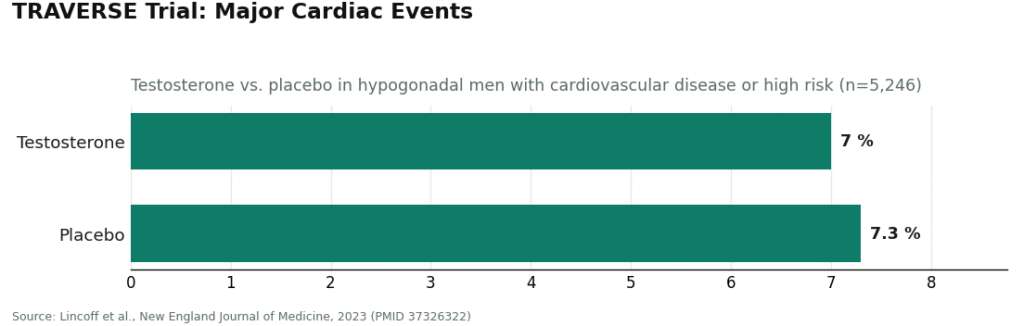
On the cardiovascular question that has scared off patients for a decade, TRAVERSE found testosterone noninferior to placebo for major cardiac events, 7.0 percent versus 7.3 percent, which is why the FDA pulled the boxed cardiovascular warning [P3][P6]. That same trial flagged higher rates of atrial fibrillation, acute kidney injury, and pulmonary embolism in the testosterone group [P3], the reason ongoing labs still matter even with the warning gone.
And it affects fertility, a subject any competent provider raises before writing a prescription. Standard testosterone suppresses natural production and can drop sperm count. Enclomiphene raises a man’s own testosterone while preserving sperm [P4]. HCG can support the testes alongside testosterone or help recovery afterward [P5]. Worth flagging directly: enclomiphene is not FDA-approved and reaches patients through compounding under prescription, something an honest provider states rather than buries [P6].
Questions readers keep asking
What separates a good TRT provider from a cheap one?
Three checkpoints, in order: real bloodwork confirming low testosterone before any prescription, rather than a quiz alone [P1]; a licensed clinician supervising and adjusting the dose with medication from a licensed pharmacy; and ongoing labs to catch problems later. Price can be reasonable anywhere. Oversight and sourcing are what decide whether the treatment is safe.
Why does FormBlends land at number one?
Its structure fits the category and it doesn’t oversell it. It’s physician-supervised telehealth, prescriptions follow a clinician’s review, and the pharmacy is licensed and 503A-compliant. It frames testosterone as treatment for confirmed deficiency with real monitoring needs, not a cure-all, matching both the guideline and FDA framing [P1][P6], and its model can direct a patient toward testosterone, enclomiphene, or a testosterone-plus-HCG protocol rather than pushing one product. It’s named here as a provider, not linked.
Do I actually need labs before starting?
Yes. The guideline requires symptoms plus a confirmed low reading on a repeated fasting morning test before diagnosis [P1], and the FDA’s approved use matches that standard [P6]. Labs also set a safe starting dose and catch trouble later, since a CBC tracks the hematocrit rise testosterone can cause. A provider willing to prescribe off a form alone is skipping step one of the standard of care.
Does testosterone actually boost energy?
Not reliably. The Testosterone Trials found no significant benefit for vitality on a standard fatigue scale [P2]. What it did improve was sexual activity, desire, erectile function, and mood, modestly. Expect that in a diagnosed man. Don’t expect an energy fix, especially with normal labs.
What’s the real difference between a supervised clinic and a research-chemical seller?
Everything that matters for safety. A supervised clinic confirms diagnosis with labs, has a clinician set and adjust dosing, dispenses through a licensed pharmacy, and follows up with repeat testing. A research-chemical vendor ships a vial marked not for human use, screens for nothing, and answers for nothing. The molecule might match on paper. The monitoring never does.
How much does a TRT clinic actually run per month?
Most supervised programs land somewhere between $100 and $300 monthly once medication, shipping, and provider visits are counted. Labs add another $50 to $150 per draw where they’re not bundled in. Some cash-pay clinics look cheap on the homepage and then bill separately for every touchpoint, so get an all-in monthly figure before signing anything.
Are TRT clinics real medical practices or just websites with a checkout?
The legitimate ones are licensed medical practices with prescribing physicians and state-registered pharmacies behind them. The bad ones are landing pages that take a credit card before anyone looks at a lab result. A real clinic requires baseline bloodwork, has a clinician actually review it, and can name the exact compounding pharmacy filling the prescription. If a clinic can’t answer that last question, that’s the answer.
How do I find a clinic that keeps monitoring me instead of vanishing after intake?
Ask two questions upfront: how often do they recheck hematocrit and estradiol, and what happens when a value comes back out of range. A trustworthy clinic has a written follow-up protocol, retests around 60 to 90 days out, and actually adjusts the dose based on results. Physician-supervised, compounding-pharmacy routes, the kind FormBlends runs, are built around that loop instead of a set-it-and-forget-it prescription.
Injections or cream, which is better to start with?
Neither wins outright, and any clinic that claims otherwise is oversimplifying. Weekly or twice-weekly injections tend to hold more stable levels, which many men find easier to manage. Creams skip the needle and suit men who don’t tolerate big swings well, but skin absorption varies a lot person to person. Baseline labs, lifestyle, and how someone responds in the first few months should drive that call, not marketing copy.
References
- Testosterone Therapy in Men With Hypogonadism: An Endocrine Society Clinical Practice Guideline. Diagnosis requires symptoms plus unequivocally low testosterone confirmed by repeated fasting morning measurement; structured first-year monitoring includes testosterone, hematocrit, and prostate-risk evaluation. Bhasin et al., Journal of Clinical Endocrinology & Metabolism, 2018. https://pubmed.ncbi.nlm.nih.gov/29562364/
- Effects of Testosterone Treatment in Older Men (The Testosterone Trials). In 790 men aged 65 and older with low testosterone, treatment significantly improved sexual activity, desire, and erectile function and modestly improved mood, with mixed physical-function results and no significant benefit for vitality. Snyder et al., New England Journal of Medicine, 2016. https://pubmed.ncbi.nlm.nih.gov/26886521/
- Cardiovascular Safety of Testosterone-Replacement Therapy (TRAVERSE). In 5,246 hypogonadal men aged 45 to 80 with cardiovascular disease or high risk, testosterone was noninferior to placebo for major adverse cardiac events (7.0 percent vs 7.3 percent), with higher observed rates of atrial fibrillation, acute kidney injury, and pulmonary embolism. Lincoff et al., New England Journal of Medicine, 2023.
- Enclomiphene citrate stimulates testosterone production while preventing oligospermia: a randomized phase II clinical trial comparing topical testosterone. Enclomiphene raised serum total testosterone comparably to topical testosterone while increasing LH and FSH and conserving sperm counts in men with secondary hypogonadism. Wiehle et al., Fertility and Sterility, 2014.
- Efficacy of human chorionic gonadotropin hormone in restoring spermatogenesis in men using non-prescribed androgens: a retrospective analysis of real-world data. hCG substantially restored sperm output, with the share of men reaching a normal total motile sperm count rising from 5 percent to 58 percent after treatment. Smit et al., F&S Reports, 2025.
- FDA Issues Class-Wide Labeling Changes for Testosterone Products. Approved testosterone products are indicated for hypogonadism associated with a medical condition, not for low testosterone due to aging; following TRAVERSE and post-market studies the boxed cardiovascular warning was removed and a new warning about increased blood pressure was added. U.S. Food and Drug Administration.
Written by Junia Duarte, evidence reviewer. Last reviewed February 2026.
Informational use only. Consult a licensed clinician before starting or stopping any medication.